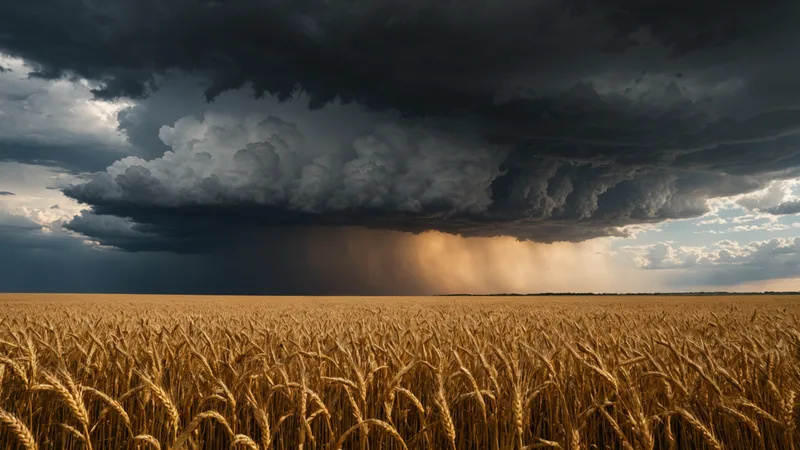
During the summer 2025 drought in the western Corn Belt, CBOT December corn futures and local cash prices moved in different directions for several weeks. Procurement teams watching only futures screens saw a market that appeared relatively stable. Teams tracking actual cash bids at country elevators in Iowa, Illinois, and Indiana saw something quite different: basis levels widening sharply, local prices spiking well above the futures implied level, and physical corn becoming scarce in specific origination markets.
This divergence was not a market anomaly. It was a predictable structural outcome of drought conditions, and understanding why it happens is essential for any procurement team that buys physical corn.
Basis: The Number That Actually Governs Your Purchase Price
The basis is the arithmetic difference between a local cash price and the nearby futures contract price. When local corn is trading at 30 cents above December futures, the basis is +30. When it is trading at 40 cents under December, the basis is -40. The basis reflects local supply and demand conditions: elevator storage capacity, regional crop conditions, transportation access, and how urgently origination points need to move grain.
Under normal harvest-season conditions in a year with a full crop, basis in the Corn Belt tends to run negative (cash below futures) because physical grain is abundant and elevators need to attract selling. During a drought year, particularly one concentrated in specific producing counties, basis can flip sharply positive or widen negative in ways that contradict what futures charts suggest about overall price direction.
A procurement team buying corn at a delivered price from a merchandiser is effectively buying the futures price plus the basis plus the freight rate. If futures are flat but basis is moving 20 cents against you over two weeks, your effective cost has increased in ways that a futures-only view would miss entirely.
How the 2025 Drought Created the Divergence
The 2025 drought pattern was geographically uneven. Certain producing areas in the western Belt experienced meaningful yield reductions, while areas in the eastern Belt came in closer to their five-year yield averages. This patchwork distribution meant that aggregate CBOT futures pricing, which reflects blended national supply expectations, did not fully capture the origination stress in specific geographies.
Elevators in affected areas faced a supply crunch at a time when buyers still needed to source physical grain. The result was a local cash premium that diverged from what futures implied. Spot prices at certain delivery points ran well above where a futures-based model would have placed them.
At the same time, the futures curve itself entered a state of backwardation, where nearby delivery months traded at a premium to deferred months. This structure signals that the market expects current tightness to ease, but it does not tell you what the actual spot price will be at your specific delivery point next Tuesday.
What Procurement Teams Relying Only on Futures Missed
The core problem with a futures-only procurement view is that it collapses a complex, geographically distributed physical market into a single price reference. Futures prices are discovery mechanisms for expected clearing prices at designated delivery points (primarily Chicago and Toledo for CBOT corn), not at your actual origination locations.
Teams that scheduled purchases based on CBOT December prices during the peak of the 2025 drought divergence found two things upon actual procurement. First, the delivered prices their suppliers quoted were substantially higher than the futures-implied level, because local cash had moved. Second, in some origination areas, physical supply was simply constrained and delivery lead times extended regardless of price level.
A third consequence, less immediately visible, was that teams that had hedged using futures were partially hedged against the national price discovery mechanism but not against the local basis risk they actually faced. Futures hedging removes exposure to the broad price direction. It does not remove basis risk.
What the Weather and Yield Data Was Showing
The soil moisture anomaly maps available through NOAA's Climate Prediction Center in late June and early July 2025 showed persistent dryness across portions of the drought-affected areas weeks before the physical market divergence became acute. The USDA crop condition ratings for corn in the same weeks were running below the prior five-year average in the affected states.
These are not obscure data sources. USDA crop condition ratings are published weekly during the growing season every Monday afternoon. NOAA soil moisture anomalies are publicly available. The challenge for a procurement desk is not access to the data: it is the bandwidth to monitor multiple data streams simultaneously and synthesize what they collectively signal about origination conditions in specific geographies.
A model that blended NOAA soil moisture readings, USDA crop condition percentages for the relevant states, and the current basis levels at key origination points would have flagged the divergence risk earlier than a futures-only view. The signals were there. They required synthesis to translate into a procurement posture.
Carrying the Lesson into Forward Procurement Planning
The practical takeaway from the 2025 corn divergence is not that futures are useless as a procurement reference. Futures markets provide essential price discovery and hedging tools. The point is that futures prices alone cannot tell you what you will actually pay for physical corn at a specific delivery point during a geographically concentrated weather event.
Effective forward procurement planning requires watching the basis alongside futures. It requires tracking the regional crop conditions that will determine whether basis is likely to firm or weaken in your origination geography. And it requires a weather signal that tells you early whether a growing season is developing in a way likely to produce the kind of regional stress that creates basis divergence.
We are not arguing that procurement teams should stop using CBOT futures as a price reference. We are arguing that futures alone give you the national expectation, not the local reality. In drought conditions, the gap between those two can be the entire question.
At Helios AI, the four-signal blend we build for each commodity specifically includes the freight and spot-price signal alongside the weather and yield signals for this reason. A forecast that treats weather, yield, freight, and price history as separate feeds rather than as a combined signal will consistently underperform in the moments when the physical market diverges from the futures screen. Those moments are precisely when procurement decisions are most consequential.
For corn procurement specifically, the early-harvest period of a drought year is when the model's ability to flag basis divergence risk is most valuable. The weather signal captures the crop stress. The yield signal captures the production reduction. The price-history signal tracks the basis movement. The freight signal captures origination access constraints. None of those four, read in isolation, gives you the full picture. Together, they tell you something closer to what you actually need to know.