ENSO, the El Nino-Southern Oscillation, is the most significant recurring climate driver for tropical agricultural commodity production. When the Pacific Ocean enters a warm phase (El Nino), rainfall patterns across Southeast Asia, West Africa, and parts of Latin America shift in ways that reduce yields for palm oil, rubber, cocoa, and sugar. When the Pacific cools into a La Nina phase, the reverse pattern brings different risks to different geographies.
For procurement teams buying any of these commodities, ENSO phase is not background meteorology. It is a material variable in the supply-risk picture that governs forward price distribution over a 12 to 18 month horizon.
How ENSO Shifts Affect Southeast Asian Palm Oil Production
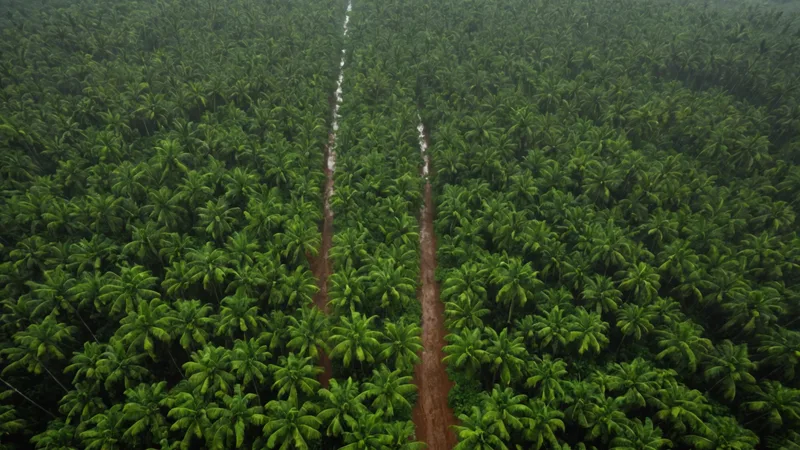
Palm oil production is heavily concentrated in Indonesia and Malaysia, which together account for the substantial majority of global palm oil supply. Both countries depend on consistent rainfall from the Inter-Tropical Convergence Zone (ITCZ) for optimal oil palm growth and fruit bunch development. Palm trees are perennial and produce year-round, but fruit bunch formation and oil content are sensitive to moisture stress during key development phases.
During El Nino events, the western Pacific warms anomalously and the Walker circulation weakens, shifting convective activity eastward. The practical consequence for Indonesia and Malaysia is reduced rainfall, more frequent dry spells, and in severe El Nino years, the elevated risk of peat fires (which burn underground peat deposits and can remove large areas of productive plantation land from production temporarily). The 2015-16 El Nino event, for example, contributed to a meaningful reduction in Indonesian palm oil output in 2015 and early 2016, with price consequences in global palm oil markets that followed with a lag of several months.
The relationship is not immediate. A shift into El Nino conditions in a given month does not produce lower palm oil output the following month. The lag between the initial moisture stress and visible impacts on fresh fruit bunch production runs several months, and the translation into price movement involves additional time as inventories buffer the initial supply change. This lag is what creates the early-warning window that a monitoring system can use.
Cocoa: West Africa and the Sea Surface Temperature Connection
Cocoa production in West Africa, primarily Cote d'Ivoire and Ghana, follows a rainfall pattern that interacts with ENSO differently than Southeast Asia. The West African harmattan (a dry northerly wind) increases in strength and duration during El Nino years, reducing moisture availability for cocoa trees during the critical pod filling period in the main crop (October through March) and mid-crop (April through September) cycles.
The ocean thermal structure of the Gulf of Guinea, specifically the upwelling patterns along the Guinean coast, also influences West African rainfall independently of Pacific ENSO. Procurement teams monitoring only Pacific sea surface temperatures will miss this Atlantic driver. The correct signal set for cocoa includes both Pacific SST anomalies and Gulf of Guinea thermal structure.
In practice, what this means for procurement teams is that cocoa supply risk during an El Nino year is elevated, particularly for the main crop, and that elevated risk should factor into forward coverage decisions made six to twelve months in advance of peak consumption periods.
Sugar: Brazil's Center-South and Southeast Asian Growing Regions
Sugar procurement is complicated by the fact that major production comes from both tropical origin (Brazil's Center-South, India, Thailand, Australia) and from different ENSO sensitivities across those origins. Brazil's Center-South, which supplies the dominant share of global raw sugar exports, is influenced by ENSO through its effect on rainfall in Sao Paulo, Minas Gerais, and Goias states. La Nina years tend to bring wetter conditions to Brazil's Center-South, supporting cane yield. El Nino years can bring drier conditions to parts of the same region, with yield consequences that vary by severity.
India and Thailand experience different ENSO sensitivities. India's monsoon is influenced by Pacific SST but the relationship is complex. Thailand's sugarcane production area in the northeast (Isaan region) is heavily dependent on monsoon rainfall, and El Nino-induced monsoon weakening in drought years can reduce Thai sugar production materially.
For a procurement team buying raw sugar for industrial or food manufacturing use, the relevant question in any given year is not just "what is El Nino doing?" but "which production origins are most exposed to El Nino stress this season, and what is their current supply position?"
Rubber: Indonesia, Malaysia, and Thailand Under Rainfall Variability
Natural rubber production is concentrated in Southeast Asian smallholder and plantation operations across Indonesia, Thailand, and Malaysia. Rubber tree tapping is directly affected by rainfall patterns: heavy rainfall reduces tapping days (latex cannot be collected during active rain), while drought stress affects tree health and latex concentration. Both El Nino and La Nina create problems, but in different ways.
El Nino periods bring drier conditions to much of Southeast Asia, which can increase tapping days (less rain interruption) but create tree stress if prolonged. La Nina brings heavier rainfall, which reduces tapping days directly. The net effect on rubber supply in a given season depends on the severity of the ENSO event, its timing relative to peak tapping seasons, and the existing health of the tree stock (which degrades after multiple years of weather stress).
How Procurement Teams Should Track ENSO Risk
The practical tools for monitoring ENSO conditions are publicly available from NOAA's Climate Prediction Center and ENSO monitoring agencies in Australia, Japan, and Europe. NOAA publishes monthly ENSO outlooks that include probability distributions for El Nino, neutral, and La Nina conditions over the following three to twelve months. These are probabilistic, not deterministic, but they provide an actionable forward view of the conditions likely to affect tropical commodity supply.
For procurement teams, the relevant monitoring practice is to check ENSO outlooks alongside yield model outputs for their specific commodities and origins on a monthly basis. The connection between ENSO phase and production consequence is not the same across all commodities and origins: palm oil in Sumatra responds differently from cocoa in Ghana or sugarcane in Mato Grosso. The signal set needs to be calibrated to the specific production regions that supply your particular commodity basket.
We are not claiming that ENSO-aware procurement means you can predict exact production outcomes. The ENSO-yield relationship is a probability structure, not a deterministic forecast. What it gives you is a better prior for how supply risk is distributed in the forward window, which is more useful than having no prior at all when you are making forward purchase decisions on 12-18 month horizons.
At Helios AI, we incorporate sea surface temperature anomalies and ENSO phase assessments into the weather signal component for all tropical commodities in our coverage list precisely because the ENSO-supply relationship is one of the most empirically consistent in agricultural climatology. It is not perfect, but it is meaningful, and a procurement team that ignores it is leaving a well-established signal off the table when making forward coverage decisions.